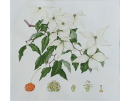
Margaret Stones (1920-2018)
Elsie Margaret Stones AM MBE was an outstanding Australian botanical artist in water colours. Stones took night classes at the National Gallery of Victoria Art School after three years of studying industrial art at Swinburne Technical College, Victoria, before training and working as a nurse through the war years. She began drawing wildflowers while convalescing from tuberculosis in 1945, having her first commercial exhibition of botanical art in late 1946. In the late 1940's she joined the University of Melbourne Botany School summer expeditions to the Bogong High Plains, Victoria, to expand her botanical knowledge and illustrate plant specimens, having three more commercial exhibitions before moving to England in 1951. Stones worked independently for the Royal Botanic Gardens, Kew, other botanical institutions, and, for a quarter of a century, was principal contributing artist to 'Curtis's Botanical Magazine', producing over 400 watercolour drawings. In 1957, she was the first woman to be commissioned by Postmaster-General to prepare a set of floral designs for Australian stamps. Commisioned in 1967 to illustrate ‘The Endemic Flora of Tasmania’, a decade long project with with botanist Dr. Winifrid Curtis, the six volumes of which have been described as one of the most significant botanical works of the twentieth century. As this project neared its end, in 1977 she accepted a ten year contract from Louisiana State University to record native Louisiana flora. The resulting 'Flora of Louisiana', published by LSU in 1991, contains over 200 of her watercolour drawings. Margaret Stones was awarded both silver and gold Veitch Memorial Medals, by the Royal Horticultural Society, Honorary Doctorates of Science, by Melbourne and Louisiana universities, and the genera Stonesia and Stonesiella are named after her.
Exhibited at: the National Gallery of Victoria; P & D Colnaghi, British Museum, and the Grosvenor Galleries, London; Fitzwilliam Museum, Cambridge; the Royal Botanic Gardens, Edinburgh; and the Ashmolean Museum in Oxford. Works held by those instititions and, among others, in the collections of Shirley Sherwood and the universities of Melbourne and Louisiana.
Paintings for sale by Margaret Stones:
Click on a thumbnail to see a larger image and more information.